Friday, August 1, 2014

10 Things to Ponder about Noah's Ark by Chris White


  Recently I have been doing some further reading about the well-known (and, one might say well-worn) story of Noah’s Ark.  I was surprised to learn a few things that I have presented here for your consideration.  If it is a true story, it will be plausible, it would have a bearing in our present reality, and more importantly it presents a call to action.  I think it meets those criteria.  Here are my thoughts:

1.  Many cultures which do not share the heritage of the Holy Bible nevertheless have a legend or oral history which follows the broad contours of the Bible story with their own variations.  These cultures are in disparate locations in both hemispheres.  Is this story widespread because it was popular and passed around a lot or is it because the peoples of the world are descended from the surviving family?
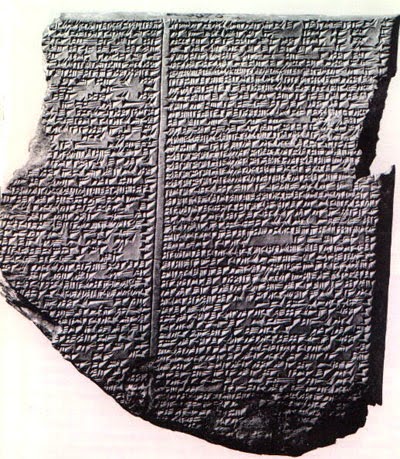
Babylonian Flood story

2.  While it seems hard to imagine features of this present world like Mt. Everest or the Swiss Alps being under 20 feet of water (15 cubits in the Bible), what if the landscape of this present world is the result of the collapsing land masses of the destroyed world and volcanic eruptions and that the previous topography was much flatter?

3.  According to the chronological and genealogical evidence of the Scripture, the world was roughly 1,656 years old when the flood occurred.  The population of the world based on natural human generation and family size would have an extremely conservative estimate of 2 billion people but more likely closer to our present day populace of 6 billion.


4. Where would enough rain be produced to cover the entire globe?  Walt Brown, Ph.D in mechanical engineering from MIT and Chief of Science and Technology at the Air Force War College suggests that the world we see today was created by a worldwide flood.  Brown suggests that the “fountains of the deep” were subterranean water sources ten miles beneath the surface of the earth.  As these broke open the tremendous force caused the water to go airborne and fall to the earth as ice, snow, and rain for 40 days.  As these sources exhausted, the plates collapsed and thus the oceans got deeper and the mountains were pushed up much higher.  Prior to this the seas and the mountains were much shallower and shorter than they are today.  (source: WND.com “Does Science Prove Noah’s Flood?”)  Another suggestion is that the rain was caused by volcanism.  The steam from a small cinder cone at Sicily’s Mt. Etna has been shown to generate enough steam to produce 4.6 million gallons per day.  What if many volcanoes were involved?

5.  As cute as the children’s story books are with Noah waving from the boat and all the animals sticking their heads out two-by-two smiling, the reality painted by the Bible account is much grimmer.  An ark is a chest used for stowing valuable things.  It was constructed of cypress (gopher) wood and then covered with bitumen or dark pitch inside and out.  It had no cabin on top and just a small skylight in the top for light and some ventilation.  In short Noah’s Ark was the original “black box”.  It sailed nowhere, it simply floated and bobbed through the water until it receded.

6.  The dimensions (which are specific in the Bible account) describe a chest with a displacement of about 43,000 tons.  This is comparable in size to the Titanic (only the Ark never sank!)  There were 3 decks in the ark, giving the interior the same cubic feet as a train of today with 1000 boxcars.  If the parent species of each animal was represented there (as opposed to the multiple, multiple varieties we have now) it would be quite plausible could all fit with room for food and people on board.


7.  Genesis is the first book of the Bible but it is not the oldest.  The oldest book of the Bible is Job and surprisingly Job references the Flood of Noah’s day.  It is also important to note that the judgment of the flood is referenced by the Prophets, Jesus, and the Apostles as something they not only believed to be true but also a paradigm for salvation and the final judgment of God.


8.  The Bible tells us the ark came to rest on the mountains of Ararat.  The tallest of this range (in present day Turkey) is 17,750 feet and has been called since antiquity “Mt. Noah”.  The Bible also tells us Noah ended his days as a viticulturist and winemaker (who apparently had a tendency to sample his work a little too much).  It is an interesting coincidence that the grape of today originates in the Near East (Eastern Mediterranean countries) and that the oldest known references to winemaking occurred in the country we know today as the Republic of Georgia, which incidentally is in the same region as Mt. Ararat.


9.  Jesus was asked what will be the sign of his Second Coming and the judgment of the world to which he replied it will be then as it was in the days of Noah (a reference to the times and culture of the people).  The only known record of this era in human history is contained in Genesis chapter four.  The societal conditions it describes are apostasy and godlessness, easy travel and mobility from place to place, city building or urbanization, polygamy and amoral sexuality, agricultural advance, production of music, advanced metallurgy, increased violence and crime.  Add to this the words of Michael the Archangel answering the prophet Daniels question about the end of the world:  “many shall run to and fro and knowledge shall increase (Dan. 12:4).”  Just before I finished this article, I booked plane tickets to take me to the other side of the world in a month. While researching this article I went to Google to ask several questions of which every single one had over 1 million potential sources of information.  I will be posting this article on my blog next and it will join the other 3.32 billion other pages on the world wide web. 

10.  If God judged the first world for its evil and Jesus says the second world (the one we live in today) will not be spared of judgment and this judgment will occur when humanity’s evil reaches a certain point, and that point of judgment has a resemblance to the culture of Noah’s day, then it follows that wise person will start looking for the ark of God’s provision.  That ark today, according to the Bible is trusting in Jesus Christ as your Lord and Savior.

Consider these words:

“ By faith Noah, being warned by God concerning events as yet unseen, in reverent fear constructed an ark for the saving of his household. By this he condemned the world and became an heir of the righteousness that comes by faith.”  (Heb. 11:7)

“ I tell you, he will give justice to them speedily. Nevertheless, when the Son of Man comes, will he find faith on earth?” (Lk. 18:8)

“ And they said, “Believe in the Lord Jesus, and you will be saved, you and your household.” (Acts 16:31)

Friday, July 18, 2014

On the Meaning of Cain and Abel by Chris White


Cain had a brother as long as he was Abel
“ By faith Abel offered to God a more acceptable sacrifice than Cain, through which he was commended as righteous, God commending him by accepting his gifts. And through his faith, though he died, he still speaks.      --Heb. 11:4

“ Woe to them! For they walked in the way of Cain and abandoned themselves for the sake of gain to Balaam's error and perished in Korah's rebellion.   --Jude 11

To think of the Cain and Abel story, one can hardly ignore how fast jealousy and anger turned to fratricide and then lying and cover-up in the earliest generation of the human family.  This tragedy continues to reverberate through human society with a worldwide homicide rate of 7 people out every 100,000 persons being intentionally murdered.  But tragic as all of that is, the story of Cain and Abel is not primarily about the origins murder in the human family but rather the emergence of two kinds of people within the human race that are truly separated by their religion.


The background of the story (found in Genesis 4) centers on the worship of God as manifested in making sacrifices to Him.  It was not a question of if Cain and Abel were going to do this but how they were going to do this.  And you must know that even if you consider yourself a skeptic or even an agnostic, this speaks of your situation as well.  Cain is the tiller of the soil and Abel is the keeper of sheep.  Both know, presumably from their parents (Adam and Eve), that offerings are to be made to God and that offering is to be.


Cain makes as his offering the fruit of his labors as a farmer.  A beautiful basket of his best produce, maybe even some choice flowers, is arranged in a basket and placed on the altar before God.  It is a large basket, the best of the best, and yet it is rejected by the Lord.  Meanwhile, his brother Abel presents the Lord with a jumbled assortment of raw meat from a lamb he has slaughtered for this sacrifice.  And the Lord has regard for Abel’s offering.


At first blush the choice of Abel’s offering over Cain’s looks a bit arbitrary and unfair (which when parents act this way with their children predictably does stir up strife and resentments).  After all, both men were offering the Lord the fruits of their respective occupations.  But the Lord called Cain out on his sacrifice and told him to do right like his brother had done.  What we can derive from this is God had already set a standard of blood sacrifice and Cain had determined he was going to do his own thing and thus be a law unto himself.  In the words of Frank Sinatra, “I did it my way!”
And so before us in this story is in microcosm the only two religions that exist among men.  To be sure men hold to all sorts of religious ideas or none at all, but they are merely differing manifestations of the ‘way of Cain’ which is to approach God on terms other than what He has prescribed.  The other religion, the way of Abel, is to approach God on his terms.  He accepted only blood sacrifices because they looked towards and pointed to His son Jesus who would become “the Lamb of God who takes away the sin of the world (Jn. 1:29).  As Peter preached to those who had rejected Jesus and had Him crucified  And there is salvation in no one else, for there is no other name under heaven given among men by which we must be saved (Acts 4:12).” 
Christ a Savior of all nations


This brings me to a final question: to which of these religions do you belong?  The answer to that question makes all the difference in the world.


Tuesday, July 1, 2014

On God's Grace, Anger Fantasies, and a Bad Muffler by Chris White


Actual Car not pictured

"Keep your heart with all vigilance, for from it flow the springs of life"
                                                                                    --Proverbs 4:23

The constraints of my situation prohibit me from elaborating, but I do have an enemy.   It's not the devil (although he certainly does appear on my list as The Enemy!) nor is it someone who is or ever has been a member of the church or on the church staff.  Thus, no need to guess or try to figure out who this person is as it really is not important.  My point in bringing this up is I was out walking (as is my custom) the other night and thinking what Pastor Rick has often referred to as "anger fantasies" about this person.  It started out as prayer but, to be honest, it quickly degenerated into thinking incoherent thoughts like "God, if you are going to forgive this person, I'm not sure I even want to be in heaven."  In that moment I heard back from God and thankfully it wasn't "okay Chris, I'll bear that in mind and judge you accordingly!"  So how did God speak to me and what did he say?  In that moment a car drove by me on this quiet street.  It's muffler was noisy enough that it caused me to look up as it went by.  On the back of the car in 10 inch letters were the words " Jesus said love your enemies!".   I wish I could say a warm rush of God's love enveloped me in that moment and that I was immediately quickened by the Spirit to actually love my enemy, but that is not what happened.  But my heart did stop its tirade and was, as the song goes, "sweetly broken" by the truth sent to me from God.  For I knew the message on the back of the car was for me and was shorthand for larger passage of scripture:

 “You have heard that it was said, ‘You shall love your neighbor and hate your enemy.’  But I say to you, Love your enemies and pray for those who persecute you,  so that you may be sons of your Father who is in heaven. For he makes his sun rise on the evil and on the good, and sends rain on the just and on the unjust.  For if you love those who love you, what reward do you have? Do not even the tax collectors do the same?  And if you greet only your brothers, what more are you doing than others? Do not even the Gentiles do the same?  You therefore must be perfect, as your heavenly Father is perfect. " (Matt. 5:43-48)

It's a hard truth, especially if you have been grievously injured by another person, yet we are not called to have warm feelings for our enemies, but to return to them the same grace God has given to us.  Its easy to forget that in the face of our rebellion and enmity towards God, God showed us His favor and grace.  He asks us to extend the same and in the doing of that we reflect in a small way His likeness and so prove to be His sons.

Wednesday, June 11, 2014

On St. Sebastian the Great Encourager by Chris White

Saint Sebastian (martyred c. 288 ad) is the patron saint of archers and protector against plagues which seems a bit absurd to me as archery was the method of the first attempt on his life. Failing to die being shot full of arrows, Diocletian ordered him to be clubbed to death. By that same logic, Sebastian should also be the patron saint of people who join clubs, go “clubbing”, or hunt baby white seals in the arctic! Actually St. Sebastian has a long history of being a beloved martyr of the Christian Church because of what he did with his life more than for his heroic death. Sebastian became a Christian in Rome during a terrible time of persecution. Rather than keep a low profile he did what some would call ‘hiding out in the open’ and joined the Praetorian guard. A skilled soldier, Sebastian was well-liked by his fellow soldiers and even the emperor. By being on the inside, Sebastian frequently dealt with Christians who were taken into custody and would encourage them to remain steadfast. In other situations he was able to relieve their suffering and give them humane treatment without drawing undue attention to himself. Eventually Sebastian was found out and was subjected to death by being shot through with arrows. When some of his fellow Christians came to bury him, they found him clinging to life and took him home and nursed him to health. Now out in the open with his faith and strong enough to walk around, Sebastian paid a surprise visit to Diocletian and denounced his cruel treatment and persecution of the Church. This criticism was met with a couple of Roman soldiers who were ordered to bludgeon him to death outside of Rome on the Appian Way. Of course Sebastian’s bravery in standing up for his fellow Christians is an example we all need in this era where the politically correct thing to do is marginalize people of faith or ignore those persecuted (as in Sudan, Iraq, Iran, and China). But I believe the greater example from Sebastian is that he made it his mission in life to encourage and strengthen those who were in a fiery trial of their faith. Never underestimate the power of encouragement. Sebastian lived out Hebrews 10:24-25 which enjoins Christians to consider how they may stimulate one another to love and good deeds and encourage each other as the day of the Lord draws near. May we all have a heart like St. Sebastian!

Friday, April 18, 2014

4 Things the Bible Teaches about Gratitude by Chris White


 So the story goes that there was a rumor floating around Oxford University that Rudyard Kipling was such a great author he was paid one schilling per word (about 8 cents US currency).  As a prank, some of the students wrote a letter to Kipling enclosing a schilling with a note reading "send us one of your words".  Kipling promptly replied with a hand-written note.  When the students opened the envelope, on a single piece of paper was the word "thanks."

  Thanks, thanksgiving, gratitude, appreciation.  These words have long been the province of religion and philosophy but now are even commonplace in psychology and self-help circles as the value of gratitude is seen to have a beneficial effect on mood and well-being.  In the context of Christianity, gratitude of the heart is actually a commandment because thankfulness to our Creator and Lord is a rich component of worship.  In this article I would like to share 4 things the Bible teaches about being thankful and how a gracious spirit of gratitude can be cultivated even is a season of depression or difficult circumstance.

   First of all, know that God wants our eyes upon Him because He is the chief reason we should be grateful.  The Lord is the giver of all good gifts in our lives.  We should be grateful for the blessings we receive but we should never separate the gift from the giver.  In his excellent audio series on heaven, author and teacher Randy Alcorn reminds us that God desires us to be excited about being in heaven with all its delights, but not the exclusion of being excited about being with Him.  All parents love giving things to their children they know will be appreciated and enjoyed, but would never want their child to only appreciate the gift.  They want to be appreciated and loved as well.

   In a rather chilling prophecy given by Moses, we read that Israel, whom God was giving a land of milk and honey (great prosperity in agricultural terms), would eventually have to be chastened by having their prosperity removed because the gift became more important than the giver: “Because you did not serve the Lord your God with joyfulness and gladness of heart, because of the abundance of all things, therefore you shall serve your enemies whom the Lord will send against you, in hunger and thirst, in nakedness, lacking everything ( Deut. 28:47-48).” It’s important to appreciate the good things in our lives, but the things should never be appreciated above the One who supplies them.

  Secondly, the Lord would have us remember Him and be grateful even in the hard places.  As Paul wrote the Thessalonian church:  give thanks in all circumstances; for this is the will of God in Christ Jesus for you (1 Thess 5:18).”  This has echoes from Job who said to his wife that God is to be praised not only when good comes our way but also adversity (2:10).  Choosing to give thanks to God on a dark day is what one author calls looking towards the sun.  One can choose to turn their face to the shadows of hard circumstance, but that is all they will see.  When you turn towards the light of God, the shadows will diminish because they are behind you.

   Matthew Henry,  the  beloved 18th century preacher and Bible commentator, was once accosted by thieves and robbed of his purse.  Following this harrowing event he wrote in his diary:  Let me be thankful first, because I was never robbed before; second, because although they took my purse, they did not take my life; third, because although they took my all, it was not much; and fourth, because it was I who was robbed, not I who robbed.  Sometimes we just need to be grateful that what happened to us wasn’t as bad as it could have been!  The true reason we continue to be grateful even in trials is that we know God is who orders every one of our days and therefore even our suffering is part of His good plan of growing us up and making us more fruitful as His servants.

   Thirdly, the spirit of gratitude in our lives can be cultivated by what we let captivate our hearts and minds.  In his letter to the Colossian church, Paul instructs “ Let the word of Christ dwell in you richly, teaching and admonishing one another in all wisdom, singing psalms and hymns and spiritual songs, with thankfulness in your hearts to God (3:16).”  The early church was a singing church as well as being dedicated to the study of the apostles.  What is striking my heart here is the powerful synergy that exists between singing and memory.  I have yet to meet a person who doesn’t remember the “ABC” song they were taught in kindergarten.  Some people I know, now in advanced age, continue to refer to this childhood song when they are trying to alphabetize files.  Singing praise and worship songs, especially ones that are based entirely on scripture, enable you to memorize the truth about God’s love and glorious person and also the hope we should take in our relationship with him.


   Having recently experienced a great trauma in my personal life, I have found my mind wandering into some very dark and unhealthy places especially when I am alone such as my commute to work or now that I am in middle age, most every night when I lay in bed awake after having gotten up to go to the bathroom.  It has been surprising to find what often consoles me and bubbles up are praise and worship songs.  Some of these songs I have been singing for years but they were not necessarily that meaningful to me.  Now they have become quite poignant and comforting.


   Psychologists and self-help experts have long practiced the use of ‘positive affirmations’ to heal the mind and body of negative thinking and to spur on personal growth.  Although the practice has some naysayers, for the most part it is a respected tool because of its overall effectiveness.  In a way, the singing of hymns and spiritual songs by a Christian is an affirmation process on steroids.  The focus is turned towards the real source of any hope or strength we can have in this life: God himself.  Which brings me to my final point.

   The ability to have a heart of gratitude is resourced in the power of the indwelling Holy Spirit.  This is what Paul speaks of in Philippians 4:12-13: “ I know how to be brought low, and I know how to abound. In any and every circumstance, I have learned the secret of facing plenty and hunger, abundance and need.   I can do all things through him who strengthens me.”  A very important point is made here.  It is not a denial of desire or need that the Christian strives to attain.  The secret of contentment then is not having fewer needs, although this can be an honest by-product of a lean period, but rather that Christ shall give the strength necessary to live joyfully even if one is wanting for something.  Of course we would do well to not exaggerate our neediness, for too often we mistake our personal greed for a need and this is not something that is gracious in the sight of God.  But the main point is God shall supply the strength we need to live in the day of blessing and the day of adversity.  We need not worry about conjuring up an attitude of gratitude but rather trust and lean into the strength the Lord has graciously provided.  Remember, the Lord may require you to walk through the valley of the shadow of death, or doubt, or depression, or deprivation, but He will never ask you to do it apart from the grace of His Spirit.  That, in itself, is something for which to be grateful.

   One author has made the piercing observation that the only difference between a monastery and a prison is the spirit of griping or gratitude.  Imprisoned criminals tend to spend every waking moment griping about their condition; while self-imprisoned saints (in a monastery) spend most of their day giving thanks to God.  However, if a criminal becomes a saint and begins offering thanks all the time, his prison becomes for him a monastery; and a saint who gives up thanksgiving, his monastery becomes its own form of a prison.  As Victor Frankl wrote, our ultimate freedom as human beings is to choose our attitude about our present circumstances.  God would have you to choose the freedom and well-being that accompanies a heart of thanksgiving.